
Living in Papamoa Beach, we are all too familiar with the power of the Pacific. We spend our mornings checking the swell at the end of the street and our evenings trying to keep the sand out of the carpet. But as anyone who has lived through the last few years in the Bay knows, when the skies open up over the Pāpāmoa Hills, the water has to go somewhere.
As we hit the mid-point of February 2026, the humidity is sitting heavy, and those subtropical lows are starting to line up. For those of us in the newer subdivisions like Golden Sands, Coast, or the developments popping up around Parton Road, we’re facing a modern landscaping challenge. We have smaller sections, larger houses, and an awful lot of “grey” space—driveways, patios, and paths.
The “Sponge City” concept is the biggest shift in New Zealand landscaping right now. It’s a move away from trying to outrun the water with pipes and drains, and toward letting the land do what it was meant to do. In Papamoa, we are essentially living on a massive, beautiful sand spit. By using permeable paving NZ systems and smart coastal drainage, we can turn our backyards into sponges that soak up the storm, protecting our homes and keeping the Bay of Plenty beautiful.
The Papamoa Dilemma: Sand vs. Concrete
There is a bit of a myth that circulates around our local BBQs: “We live on sand, so we don’t have drainage problems.” In a perfect world, that’s true. Pure sand is the ultimate filter. However, the way we build today has changed the equation. To get a stable house platform, we compact the ground, lay down heavy clay-based fill, and then cover 50% or more of the section in traditional, “impermeable” concrete.
When a classic Papamoa downpour hits, the rain that used to disappear into the dunes now hits these hard surfaces and gathers speed. In a tight subdivision, if your patio isn’t perfectly graded, that water is heading straight for your garage or your neighbor’s fence.
This is why the Tauranga City Council is getting much stricter about “site coverage” and “impermeable surface” limits. If you are planning a backyard renovation in 2026, you’ve likely hit a wall with your “pervious to impervious” ratios. If you want that extra-wide driveway for the boat or a larger patio for the outdoor kitchen, you might be told “no” – unless you can prove the water stays on your section. This is exactly where permeable paving NZ becomes your best friend.
What Exactly is Permeable Paving NZ?
We get asked this a lot down at the yard. People often think it’s just a “holey” brick, but it’s actually a complete engineering system. Unlike a standard concrete slab that acts like a roof over the earth, a permeable system is designed to “breathe.”
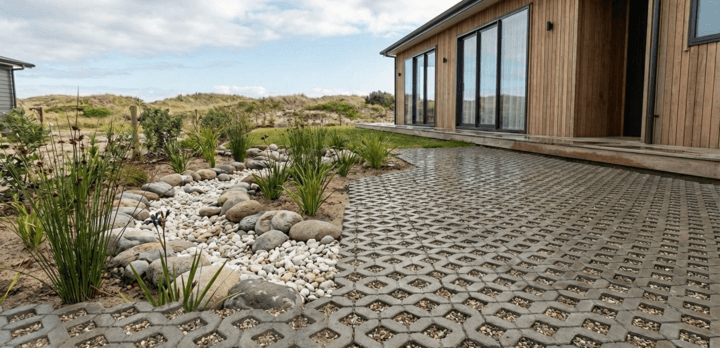
The system starts with what’s underneath. Instead of a standard GAP base that packs down tight, we use specific drainage aggregates – clean, crushed stones with no “fines” (the dusty stuff). This creates a sub-base full of tiny air pockets. On top of that, we use specialised pavers. Some are “porous” (the water goes through the stone itself), but most are interlocking pavers with slightly wider gaps that are filled with tiny, clean stone chips.
When the rain hits, it drops through the gaps, fills the reservoir of stones underneath, and slowly filters into the Papamoa sand. It is a “cheat code” for landscaping because most councils treat these surfaces as “pervious.” This means you can have your dream outdoor area while still checking every box for building consent. Plus, it looks significantly more high-end than a plain old slab of grey concrete.
Designing a “Coastal Rain Garden” for Papamoa Conditions
Drainage doesn’t have to look like a plastic grate in the middle of your lawn. In fact, some of the most beautiful gardens in Papamoa right now are “Rain Gardens”. These are shallow, planted depressions designed to catch and filter runoff from your roof or non-permeable areas.
Because we have such a distinct coastal vibe here, we can make these look incredibly natural. Think of it as a “dry creek bed.” You can line the area with a mix of white pebbles, river stones, and larger schist boulders. It creates a textural feature that looks like a slice of the local beach environment.
During a dry January, it’s a stunning rock garden that requires almost zero weeding if you’ve used a quality weed mat and deep stone layer. But when a tropical low rolls in from the Pacific, it becomes a functional reservoir. The water pools there temporarily, filtered by the stones, before being absorbed by the thirsty plants and the sand below.
The Best Plants for a Papamoa Sponge Garden
You can’t just put any old plant in a drainage area. In Papamoa, your plants need to be “all-weather” athletes. They need to handle “wet feet” during a winter storm, but also survive the blistering salt-laden winds and the six-week droughts we get in summer.
Here are the top picks we recommend for our local climate:
- Oioi (Jointed Wire Rush): This is the gold standard. It’s a native rush that looks incredibly modern with its grey-green stems and rusty orange tips. It loves a damp hollow but is perfectly happy in dry sand.
- Knobby Club Rush (Ficinia nodosa): You’ll see this growing naturally on the dunes at Papamoa Beach. It forms tight, bright green balls that look fantastic when planted in groups. It’s virtually indestructible.
- Harakeke (NZ Flax): Especially the smaller, variegated varieties. They are massive drinkers when water is available and act as a natural filter for the soil.
- Coastal Rosemary (Westringia): While not a native, it handles the Papamoa salt spray like a champ and provides a soft, grey-green contrast to the sharp lines of permeable paving NZ.
Why Local Knowledge and Supplies Matter
When you are building a permeable system or a rain garden, the “ingredients” matter. You can’t just use any old gravel from a big-box store. If your drainage stone has too much dust in it, it will “clog” the system, and within two years, your permeable driveway will be just as waterproof as a sheet of glass.
Because our yard is right here in Papamoa, we know exactly what is under your topsoil. We understand the high water table issues around the Te Tumu end of town and the shifting sands closer to the coast. We stock the specific clean-washed aggregates and high-performance geotextiles that are required to make these systems work long-term in a coastal environment.
Choosing a local supplier means you are getting materials that have been tested in our specific conditions. We can tell you which white pebbles won’t turn yellow in our salt air and which pavers will handle the intense Bay of Plenty UV without fading.
The Bottom Line: Future-Proofing Your Paradise
As we move further into 2026, the trend of “resilient landscaping” isn’t going away. Homebuyers are becoming savvy—they aren’t just looking at the kitchen benchtops anymore; they are looking at the driveway. Seeing a high-quality permeable paving NZ system tells a buyer that the home is built for the future. It says the owner has invested in property protection and followed the rules.
Creating a “Sponge Garden” in Papamoa is about more than just avoiding a puddle by the back door. It’s about being a good neighbor, reducing the load on our city’s infrastructure, and creating a low-maintenance, high-style backyard that lets you spend your weekends at the beach rather than out there with a shovel trying to dig a trench in the rain.
Ready to protect your Papamoa patch?
Stop by our yard on your way back from the beach this week. We have the permeable pavers on display so you can see the textures for yourself, and we’ve got all the drainage aggregates, pebbles, and native-friendly soils you need to get the job done right. For more technical details on how these systems work in a NZ context, take a look at the Water New Zealand SuDS Resource.